Thursday, March 31, 2016

Digging Deeper into Digitized Microfilm at Library and Archives of Canada: Indexed and Non-Indexed Items Related to Upper Canada Land Petitions

In the process of writing about some more online resources for early Ontario I realized my article/post would be better split up into at least two but maybe three articles/posts. Here's the second of those articles/posts. This is sort of long but I think worth it.

Library and Archives of Canada
Current Website
So you go to the digitized microfilm websites for the Library and Archives of Canada, yes there are two, select an interesting collection and you see columns or tables of "coded" digitized microfilm ... possibly even pages of these for a single collection.

And since this collection has no online index, you wonder what is sitting there? What am I missing out on? So you click and peek, then click more and eventually find some descriptions telling you about what you've seen but some collections do not seem to explain much.

Let me save you time and tell you what I learned about a handful of the digitized microfilm collections related to land records for what is now Ontario (formerly Canada West formerly Upper Canada.)

Library and Archives of Canada
Archived website
First, in general, there is a lot out there but not everything mind you. Second, you are not going to find these things if you expect everything to be delivered with a few keystrokes, an enter key and a mouse click. You have got to explore and browse (safely keeping your wits about you so you don't get virus/malware by accidentally clicking on an ad) and put in a little effort to see what libraries, archives, museums and even societies are adding to their websites.

So I made room in my schedule and returned once again to the Library and Archives of Canada (LAC) website to investigate further. As I stated above LAC uses two different websites to hold its digitized microfilm rather than have the digitized film on its current LAC website. The digitized microfilm sits at the archived Library and Archives Canada website and the Héritage website. (You can tell the difference between the current LAC website and the archived website by the color -- blue for the current and red for the archived.) The online indexes for some of the LAC digitized microfilm collections are located at the current LAC website at the Genealogy and Family History page. So in reality there are three websites involved in this adventure.

Héritage website
So what is what with that digitized microfilm? Rather than write a paragraph or two about each collection I decided to format what I learned into hopefully a clear and concise summary. This summary tells you the online title of the collection; if there is an online index; the website holding the digitized microfilm with a direct link; the title used in the catalog with collection codes and MIKAN number from LAC; the number of microfilm reels or the microfilm numbers with a brief description; any notes I made in regards to the collection; and whether the Archives of Ontario has microfilm copies of that collection.

I tried to be thorough so hopefully I did not make any errors. See yesterday's post on two tips for searching the catalogs of the Archives of Ontario and the Library and Archives of Canada.


Upper Canada Land Petitions, 1763-1865
Online Index: Yes, at LAC website (info and search)
Digitized Microfilm: Yes, at archived LAC website
Land Submissions to Executive Council 1783-1865, predominant 1783-1841 (formerly RG1 L3 and RG1 L6B now R10875-4-5-E), MIKAN 205131
327 Reels:  contain the petitions and related records submitted to the Executive Council, sitting as a land committee in the performance of its land disposal functions. The “land committee” dealt with all manner of petitions for grants and leases, requests for title deeds and reports from the Surveyor General or, after 1827, the Commissioner of Crown Lands.

Note: The Upper Canada Land Petitions 1763-1865 (formerly RG1 L3 and RG1 L6B now R10875-4-5-E) along with the Upper Canada Sundries 1766-1841 (formerly RG5 A1 now R10875-2-1-E) were electronically indexed  and are available in one index at the LAC website under Land Petitions of Upper Canada, 1763-1865. The digitized microfilm for the Upper Canada Land Petitions is located at the archived LAC website.

At the Archives of Ontario:  Upper Canada Land Petitions diffusion material D 29 see user’s guide to Upper Canada Land Petitions and Land Books for detailed descriptions and microfilms. (Microfilm numbering systems are different at just about every archive/library.) At AO, D 29 also includes the two card index sets mentioned below under Upper Canada Land Books which indexes both the petitions and land books.


Upper Canada Sundries
Online Index: Yes, at LAC website (info and search)
Digitized Microfilm: Yes, at Héritage website
Civil Secretary’s Correspondence, Upper Canada, Upper Canada Sundries, 1766-1841 (formerly RG5 A1 now R10875-2-1-E), MIKAN 125539
94 Reels:  The series consists of letters, petitions, reports, returns and schedules, certificates, accounts, warrants, legal opinions, instructions and regulations, proclamations and other documents received by the Civil Secretary of Upper Canada, 1791-1841.

Note: The Upper Canada Land Petitions 1763-1865 (formerly RG1 L3 and RG1 L6B now R10875-4-5-E) along with the Upper Canada Sundries 1766-1841 (formerly RG5 A1 now R10875-2-1-E) were electronically indexed  and are available in one index at the LAC website under Land Petitions of Upper Canada, 1763-1865. The digitized microfilm for the Upper Canada Sundries is located at the Héritage website. The online digital microfilm for this collection references RG1 L1 instead of RG5 A1 and I am not sure why there is a discrepancy.

At the Archives of Ontario:  Upper Canada Sundries diffusion material see inventory D 23 for microfilm numbers. In addition, the Archives of Ontario has a couple of related collections not at LAC so see the Archives Descriptive Database for the Sundries to learn more.


Minutes and Records of the Land Boards Accumulated by the Executive Council Office
Online Index: Yes, at LAC website (info and search)
Digitized Microfilm: Yes, at Héritage website
Minutes and Records of the Land Boards Accumulated by the Executive Council Office, 1765-1804 (formerly RG1 L4 now R10875-7-0-E), MIKAN 205141
Reels:  H-1760, H-1761 contain the card index to the minutes and records in this collection. Each card gives, name, location, summary, collection, volume and page and microfilm reel. Check all alternate spellings.
Reels:  C-14026, C-14027, C-14028 contain the minutes and records of the land boards of the Hesse, Nassau, Luneburg and Mecklenburg Districts and their successors following subdivision of the districts, 1765-1804.

Note: The Minutes and Records of the Land Boards Accumulated by the Executive Council Office, 1765-1804 (formerly RG1 L4 now R10875-7-0-E) was electronically indexed and is available at the LAC website, under Land Boards of Upper Canada 1765-1804. (See above.)

At the Archives of Ontario:  Upper Canada Land Board Minutes and Records diffusion material see inventory D 359 for microfilm numbers. In addition, the Archives of Ontario has a couple of related collections not at LAC so see the Archives Descriptive Database for the Land Board Minutes to learn more.


Upper Canada Land Books
Online Index: No (but card index is microfilm is digitized see below)
Digitized Microfilm: Yes, at Héritage website
Land Minute Books  of the Executive Council, 1787 – 1841 (formerly RG1 L1 now R10875-2-1-E), MIKAN 205068
Finding Aid MSS1802 Index to the Upper Canada Land Petitions (RG1 L3) and the Executive Council Minute Books on Land Matters (formerly RG1 L1 now R10875-2-1-E) commonly called the Upper Canada Land Index.
Reels:  C-100, C-101, C-102, C-103, C-104, C-105, C-106, C-107, C-108, C-109, C-110 contain Minutes of the Land Committee of the Executive Council of Upper Canada, 1787-1841. These records are commonly called the “Land Books.” Originally labeled volumes A through U later these volumes were assigned  volume numbers 18-39 for cataloging. Also included are the Minutes of the Land Committee of the Executive council of the united Province of Canada, 1841-1867. Again, originally labeled using letters and later given the volume numbers 40-48 for cataloging. Each volume starts with nominal index of petitioners.
Reels:  H-1976, H-1977, H-1978 contain a supplementary card index to the Upper Canada Land Petitions (RG1 L3) and Executive Council Minute Books on Land Matters (formerly RG1 L1 now R10875-2-1-E) which was filmed in 1991.
Reels: C-10810 thru C-10836 contain a card index to the Upper Canada Land Petitions (RG1 L3) and Executive Council Minute Books on Land Matters (formerly RG1 L1 now R10875-2-1-E) which was filmed in 1981.

Note:  Be  thorough if you use these and check both card indexes which make up Finding Aid MSS1802. Though these two card index sets include both the Upper Canada Land Books and the Upper Canada Land Petitions, the online index to the Upper Canada Land Petitions does not include these Upper Canada Land Books.

At the Archives of Ontario:  Upper Canada Land Books diffusion material see inventory D 355 for microfilm numbers. (AO refers to this collection as RG1 E1 at National Archives but LAC has it as formerly RG1 L1 now R10875-2-1-E.) At the Archives of Ontario, these card index films (both sets) are part of Upper Canada Land Petitions diffusion material D 29 see user’s guide to Upper Canada Land Petitions and Land Books for detailed descriptions and microfilms.

See my next article/post for a “cheat sheet” to this digital microfilm collection.


Index to Grants, Deeds, Leases and Licenses of Occupation Unclaimed or Impounded in the Executive Council Office
Online Index: No (this digitized microfilm is a card index)
Digitized Microfilm: Yes, at Héritage website
Finding Aid MSS1803 (card index) to Grants, Deeds, Leases and Licenses of Occupation, Unclaimed or Impounded in the Executive Council Office, 1791-1897, predominant 1791-1848 (formerly RG1 L2 now R10875-6-9-E), MIKAN 205137
Reels:  C-11961, C-11962, C-11963 contain the Finding Aid MSS1803 card index by name (on reels 11961 and 11962) and by township (on reels 11962 and 11963). Do read the description at the beginning of the reel to learn how to read the cards and the limitations of the index. This is a card index to a collection (which is not microfilmed) that consists of two distinct types of documents: deeds for grants and leases of land, surrendered to or impounded by the Executive Council of Upper Canada for a variety of reasons; and the technical descriptions of unclaimed grants and leases. See the catalog description for further information.

At the Archives of Ontario, No.


Land Documents Concerning Quebec, Upper and Lower Canada, Canada East and Canada West and Canada
Online Index: No
Digitized Microfilm: Yes, at Héritage website
Registrar General, Land Documents, 1763-1952 (formerly RG68 now R1002-147-2-E), MIKAN 787982
53 reels:  originals and registers containing copies of leases, releases, deeds, grants, surrenders, sales, letters patent of land and related documents for Crown and Clergy Reserves, Indian and Ordnance Land, Dominion Land, etc.

At the Archives of Ontario, No.


Licenses, Upper and Lower Canada, Canada East and Canada West and Ontario, 1817-1867
Online Index: No
Digitized Microfilm: Yes, at Héritage website
Registrar General, Licenses, 1817-1867 (formerly RG68 now R1002-82-0-E), MIKAN 192630
Reels:  C-3947, C-3948, C-3952 contain registers of licenses for the practice of physic surgery and midwifery, register of medical licenses, returns of licenses issued for innkeepers, billards and wholesalers in Upper Canada. There is a note that other items may have been filmed on these films so you have to look for the start of the register you seek on the “film.”

At the Archives of Ontario, No.


Heir and Devisee
Online Index: No
Digitized Microfilm: Yes, at Héritage website
Records of the Heir and Devisee Commission Accumulated by the Executive Council, 1777-1854 (formerly RG1 L5 now R10875-8-2-E), MIKAN 205142
21 Reels:  consists of records of the Heir and Devisee Commission forwarded to the Executive Council Office in the course of business, as well as records accumulated by the Executive Council Office after the demise of the first Commission in 1805. Records include minutes, reports and recommendations, notices of claims, and documentation submitted in support of claims (such as bonds, certification, location tickets and affidavits.)

At the Archives of Ontario:  First Heir and Devisee Commission diffusion material see finding aid D 352 for microfilm numbers. In addition, the Archives of Ontario holds the similar records for the later (sometimes referred to as Second) Heir and Devisee Commission. See the Archives of Ontario's Archives Descriptive Database for more information


These primarily land related digitized microfilm collections that I have highlighted are but a few of those available. There are other collections covering other aspects for what became Ontario, such as the Marriage Bonds that I mentioned in an earlier post. There are also many other online digitized microfilm collections for the other provinces of Canada. Some of those digitized microfilm collections even have online indexes available so check out the Genealogy and Family History page at the current LAC website.

I plan to post the third article next week.


©2016 All Rights Reserved, goneresearching. All text and photos in this post are copyrighted & owned by me (goneresearching) unless indicated otherwise. No republication (commercial or non-commercial) without prior permission. You may share (tell others) of this blog as long as you give credit and link to this site (not by downloading or copying any post). Thank you.

Wednesday, March 30, 2016

Two Tips for Searching the Holdings of Two Canadian Archives from their Websites

In the process of writing about some more online resources for early Ontario I realized my article/post would be better split up into at least two but maybe three articles/posts. Here's the first of those articles/posts.

I don't know about you but I find most online catalogs for the holdings of libraries fairly easy to search. There are enough clearly labeled, understandable search filters in order to make the search engine do what you want it to do -- find meaningful results. But when it comes to the online search/databases for the holdings of archives I seem to pull out more hair than results. These particular search engines do not seem to be so public-friendly.

Here are two things I learned to draw some results out instead of hair. Of course, if items have not been added to the online catalog by the archive/library no amount of searching will find them.

Do you want to find out what the Archives of Ontario has that is from other libraries/archives, such as the Library and Archives of Canada or elsewhere? Knowing this could save you a trip, or allow you to spend more time on collections not available by other means.

Archives of Ontario
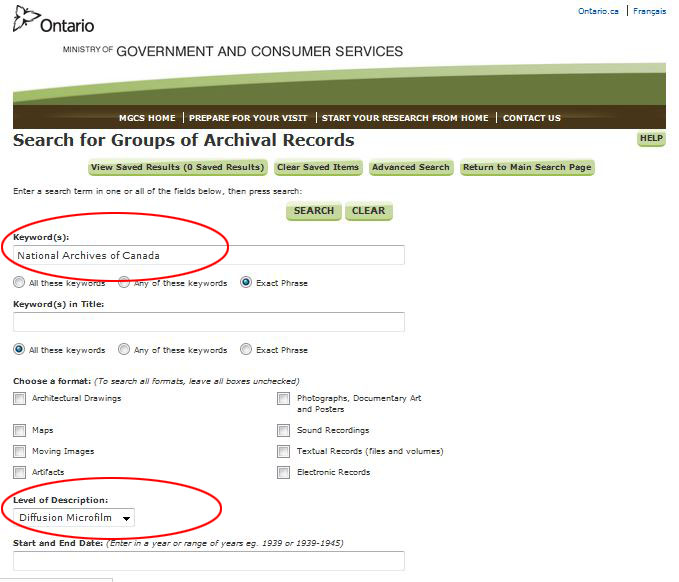
At the Archives of Ontario website's Archives Descriptive Database, go to the Advanced Search and use the "Search Groups of Archival Records" option. Once there, change the Levels of Description from "All Levels" to "Diffusion Microfilm" option. (Duplicated items from other libraries/archives are often on microfilm.) If you want to see results from any location leave all other filter fields blank and hit search. As of yesterday, this gave me 401 results of items that originate from the holdings of other libraries/archives/entities.

Want to see what items came from just a particular place? Along with "Diffusion Microfilm" for the Levels of Description, enter that particular place in the keyword field. The trick to this is knowing/realizing what name the Archives of Ontario used for that originating entity. In the case of the Library and Archives of Ontario, enter "National Archives of Canada" in the keyword field. As of yesterday, this gave me 55 results.

I knew I had used some materials during my 2012 Archives of Ontario visit that are now digitized by the Library and Archives of Canada, I just needed to find the online description to confirm it and searching by item name was not working. (I will not say how long this took for me to solve.)

I am not positive if the Archives of Ontario has any items from the Library portion of the Library and Archives of Canada or not. If the Archives of Ontario does, you should find them in the non-specific "Diffusion Microfilm" search. Once you learn how the Archives of Ontario named the originating entity you can revise your search to just focus on that one place.

Do you want to know an alternate way to bring a description up for a collection? This might not work everywhere but there might be a similar cataloging feature that works in your favor.

Library and Archives of Canada
Now over at the Library and Archives of Canada's website, I was having a problem bringing up a collection description in the Archives Search. From the online digitized microfilm description information I tried the RG number, I tried the name of the collection and nothing was working.

So then I realized that the online digitized microfilm description showed a MIKAN number. I seem to have remembered this number was unique and sure enough under the Archives Search using Advanced Search I could change the "any keyword" to "MIKAN number" and enter just the MIKAN number to find the description result I wanted.

I wondered what exactly a MIKAN number was so I searched for the answer. From one of the results -- the LAC's own blog site, I learned that "MIKAN is a computer system for searching, creating, and modifying information about archival materials." The MIKAN system automatically assigns a unique record number to a record at all levels of description (fonds, series, accession, file, item.) It gets placed on everything because it is mandatory field. I don't know if the MIKAN system is used by all (or just some) Canadian archives, or if other archives elsewhere use it or a similar system. Regardless, I doubt a MIKAN number for an item at one facility would be the same at another.

I think part of the problem I was having in this case is that the online collection name does not always exactly match the collection name in the holdings. Another problem is that quite a few of the Archives descriptions appear to be in the process of revision.

So if you are having problems searching a catalog, take a moment to study the advanced search interface to see if you can determine what filter fields you have to work with and try an alternate method. Of course, see if there are any help guides or videos available to view. If these do not hold your answers, often there is a way you can contact a library/archive staff representative and ask a question. But you may need to wait for an answer, especially if you are searching after hours.

Hopefully tomorrow I will post the article I intended to write.

©2016 All Rights Reserved, goneresearching. All text and photos in this post are copyrighted & owned by me (goneresearching) unless indicated otherwise. No republication (commercial or non-commercial) without prior permission. You may share (tell others) of this blog as long as you give credit and link to this site (not by downloading or copying any post). Thank you.

Wednesday, March 23, 2016

Early Protestants in Early Canada? Check the Marriage Bonds 1779 - 1858, Upper & Lower Canada

Library and Archives Canada
I am working very hard at balancing life and my "planned genealogy tasks" these days. But one find is leading to another and now yet another. Last year was a busy year and it appears I may have missed seeing/hearing of a third digitized collection for Canada.

So I took a small pause from working on/updating what is currently in my genealogy program to share yet another discovery.

Over at the Library and Archives of Canada in the Genealogy and Family History area, there are quite a few digitized collections. Under the Births, Marriages and Deaths category is a collection entitled, Marriage Bonds, 1779-1865 - Upper and Lower Canada.

Now I don't know exactly when this collection was added to LAC but the Marriage Bond page was last updated in February 2015. I don't remember if this collection was there at the time I discovered the Upper Canada Land Petitions in 2011/2012 or not. I did do a little search test and it appears these bonds are not over at Ancestry.com or at any of its variations. They also do not appear online at the FamilySearch.org website.

So what is a Marriage Bond? It's like an intention to marry or "official engagement." According to the LAC's record description for the collection, "The groom was required to enter into a bond with one or two people (sureties) who knew him and who were prepared to guarantee to the Crown that there was no legal impediment to the marriage. After obtaining the bond, a license was issued and the marriage took place a few days later."

In this case, these marriage bonds were prepared only for Protestant marriages by license.

So if you have ancestors in early Canada who were Protestant (or married Protestant) and you have not found them in the records of a church or pastor, you might want to search this collection.

On a bond you will find the names of the future husband and future wife and their place(s) of residence; the names of those acting as sureties; and the date and place where the bond was issue. (Often those acting as sureties were related to either the future husband or future wife.) Now remember marriage bonds were usually issued a few days prior to the actual ceremony, so the date on the bond is not the date of the actual marriage -- the marriage date was soon after the bond date.

These marriage bonds for Protestants are important because marriage licenses issued before 1867 were not retained by the government. This digitized collection is made up of bonds from two collections:

  • 7,899 marriage bonds for Upper Canada (Ontario) issued between 1803 and 1865 -- RG 5 B9 (MIKAN 125556)
  • 2,960 marriage bonds for Lower Canada (Quebec) issued between 1779 and 1858 -- RG 4 B28 (MIKAN 125694)


Here are some of my tips for the Marriage Bonds collection. Unlike other LAC digitized collections, these digital images are linked to your search results. Instead of searching a separate page with the digitized microfilm, here you simply click on the link to see the image desired.


Results Husband Search
Library and Archives Canada
Search Future Husband Surname
Library and Archives Canada


There are separate search filters for "future husband" and "future wife." So to do a complete, thorough surname search you have to search for your surname at least twice, once using "Future Husband's Surname" and once using "Future Wife's Surname." (Now if your surname has a lot of variations you will have to search those variations also. As far as wildcards, it looks like the multiple character (*) is supported at the end of a name. The single character (?) in the middle of a name did not work for me.)


Search Future Wife Surname
Library and Archives Canada
Results Wife Search
Library and Archives Canada


After getting your search results, to see an image simply click on the "item number" link for the result you want to investigate.


Item Page - Second Image
Library and Archives Canada
Item Page - First Image
Library and Archives Canada


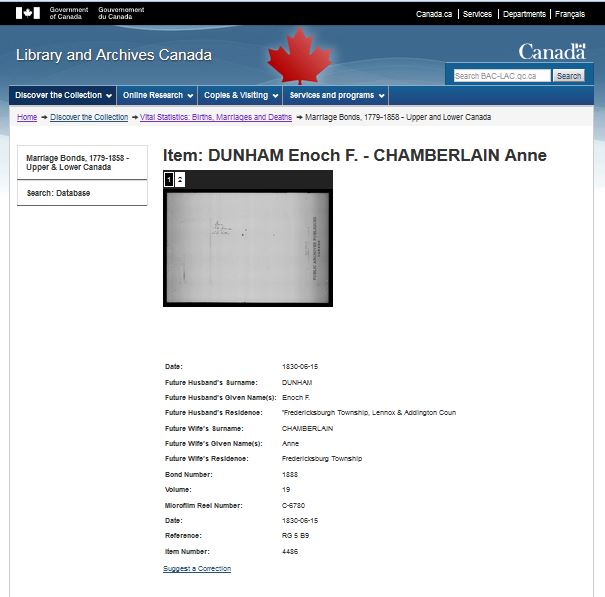
At the Item page you will see there are two images (front and back) of the bond; some information abstracted from the bond; and details of the microfilm collection from which the bond was digitized.

Though you can scroll the image larger on this page, if you click on the image you can get a larger view. BUT to see the second image you need to go back to this initial Item page and click on the "2."


Enlarged Image
Library and Archives Canada
If you want to download the bond images, do so from the Item page where you will download via right-click a jpeg (jpg) of the image. If you try to download via right-click the image from the larger view, it only lets you download a png image. In this case, the jpg would likely work best.

In comparison to some other digital collections on LAC, these images of the Marriage Bonds appear to not be scanned as well. You simply can not enlarge the images, those online or downloaded, very much before the image goes "diggy."


Detail from Marriage Bond of Enoch F. Dunham
and Anne Chamberlain 15 June 1830 , Library and Archives Canada
RG 5 B9, vol. 19, number 4486 
I did not find any relatives in this particular collection which was a little disappointing. The Enoch F. Dunham that appears in these example images is from another Dunham line, Rev. Darius Dunham.

©2016 All Rights Reserved, goneresearching. All text and photos in this post are copyrighted & owned by me (goneresearching) unless indicated otherwise. No republication (commercial or non-commercial) without prior permission. You may share (tell others) of this blog as long as you give credit and link to this site (not by downloading or copying any post). Thank you.

Friday, March 18, 2016

Digitized Land Patent Plans at Archives of Ontario

Digitized Patent Plans
Archives of Ontario
I discovered another land records related digitized collection for Ontario on Wednesday while in the process of confirming that a recently digitized collection (Thomas Talbot Fonds) was indeed the one sitting on my To-Do Research List since 2012.

From what I can tell I think the Digitized Patent Plans collection on the Archives of Ontario website has been accessible since last June perhaps April. Some how this escaped my attention.

What are the Digitized Patent Plans? Essentially they are maps showing the status of Crown Lands (patented, leased, licensed) by indicating the name of the individual who first received the patent/lease/license for a particular plot of land and often the year received.

These images (high-res jpegs that are zoom-able and downloadable) are of the plans in the Ontario Government Record Series RG 1-100 Patent Plans. According to the Archival Records Description there are 4,201 plans in the record group. Currently, the Digitized Patent Plans page says more than 4,100 plans are digitized. So it looks like they are close to completing digitization of this collection.

Most of the digitized images are readable, however, I have come across some that could have been either scanned or color corrected (tweaked) better to make them more readable.
Visual Database
Archives of Ontario

To find the digitized plans, you can use The Archives of Ontario Visual Database using just keyword search, or use the Advanced Search option using keyword and RG 1-100 in the Reference Code filter to limit results just to the patent plans.

I suggest using the just the name of the township as the keyword because the county name does not appear anywhere in the item description. (Remember, spelling counts even if the entry is misspelled itself, i.e. Ameliasburgh Township has two entries spelled Amerliasburgh.)


Use the reference code filter if too many other images appear besides the various plans for the township. (The image descriptions do not indicate the year a plan was initially drawn, so you'll have to find that on the plan itself.)

Another way to view the digitized plans is to view the item-level listing from the Archival Records Description for RG 1-100. (This is how I discovered the misspelling noted above.)


Since there is no person name index to these patent plans that means you have to browse and look at the images rather than enter a name for a results list. These names on the patent plans are the first individual owners. For later person to person sales, you need to look at the records of the County Land Registry Offices.

These digitized Patent Plans are a wonderful complement to the Land Petitions of Upper Canada, 1763-1865 indexed and digitized by the Library and Archives of Canada a few years ago.

The petition papers (not just for United Empire Loyalists) are name indexed but the digitized images are not automatically linked to the results entry. (For the Library and Archives of Canada's digital collections, you have to separately digitally browse to locate the digitized microfilm using information in the search results entry and then browse for the image of the document you desire.)


It really helps to know where your ancestor received his/her land before doing a "Where's Waldo" on a patent plan. Sometimes the margin notes in the petitions say what land (county, concession, lot) was granted but not always. So in many cases you have to refer to the Land Books or Minute Books of the Land Boards (abolished in 1794) or Executive Council Office. The land books of the earlier Land Board (RG 1 L4) are also digitized and indexed up to about 1804 though mostly before 1794, but the Land Books/Minute Books of the Executive Council are still just on microfilm.

Sometimes you can also learn the specific concession and lot from a census record, county directory, or county atlas. Of course, in these cases there is no guarantee that your ancestor was the first individual owner of that land. But it is not too hard to browse the digitized patent plan when you know the township, concession and lot.

So from my previous research with the digitized Land Petitions at the Library and Archives of Canada website and then research in the Land Books/Minute Books microfilms at the Archives of Ontario, I searched the Digitized Patent Plans for the townships I needed.

John Dunham
York Twp, Conc. I, Water Lot B
Archives of Ontario

For some of my various ancestors I had already taken the research from documents to modern-day maps to have a real understanding of where my ancestor lived. But for one of them that I had not done so yet I learned something interesting.

According to a Index to Land Patents by District entry, one of my John Dunham guys (not certain which one at this time) was granted or bought from the government: 1 acre in York County, York Township, Concession I, Water Lot B opposite town lot no. 6. At that time this was on Peter Street (formerly King Street) between Frederick and Caroline Streets. (Note that this particular Patent Plan was one of the blurriest I came across when looking at the plans. I have tweaked/brightened this detail in PhotoShop a little.)

The Same Land Today
(Streets Have New Names)
Google
Today, this same 1 acre is now part of Toronto on Front Street East between Frederick and Lower Sherbourne Streets and it appears part of the Toronto Public Library St. Lawrence branch sits on that very site. Yes, street names can change over the years. Check out the Front Street or King Street page on Wikipedia for more details of the name changes through history.


Unfortunately at the time we were at the Archives of Ontario doing this land research, we could not find the microfilm of the land book containing this specific patent. If we had found it we might have been able to determine which of my John Dunham guys was involved with this patent. So that aspect remains on my To-Do Research List for the Archives of Ontario.

To understand the Land Records in Ontario, read The Archives of Ontario Research Guide 215: From Grant to Patent: A Guide to Early Land Settlement records, ca. 1790 - ca. 1850 found in Word or PDF format on the Research Guides and Tools page of the Archives of Ontario website. If any of the links above return an expired session, just click on start new session. Most of these pages can be reached by going to MCGS Home page and then going to the Accessing Our Collection page and scrolling to the pages mentioned.

Finally besides the Land Petitions, the Library and Archives of Canada's Genealogy and History page contains links to a variety of its record collections that have been digitized.

Now to get back to the part of my genealogy that I had planned to work on this week.


©2016 All Rights Reserved, goneresearching. All text and photos in this post are copyrighted & owned by me (goneresearching) unless indicated otherwise. No republication (commercial or non-commercial) without prior permission. You may share (tell others) of this blog as long as you give credit and link to this site (not by downloading or copying any post). Thank you.

Wednesday, March 16, 2016

Ontario Land Settlement Surveys from The Thomas Talbot Fonds Digitized by Elgin County Archives

It looks like another bright shiny object (BSO) has come to my attention. Though it really looks like it has the potential to be a big rabbit hole to get lost in if you have a lot of ancestors in this particular area and time period.
Thomas Talbot Fonds Digitized
Elgin County Archives

Over at Olive Tree Genealogy today, I discovered that part of what is on my To-Do List for a return trip to the Archives of Ontario has been digitized and is now available online. Yeah!

The Elgin County Archives, as part of  the Archives of Ontario's Digitization Loan Program, has digitized from the Archives of Ontario The Thomas Talbot Fonds F 501.

Besides individuals petitioning for a grant of Crown Land to eventually earn a patent to that land, there were land promoters who leased or sold land for settlement. The Archives of Ontario Research Guide 215: From Grant to Patent: A Guide to Early Land Settlement records, ca. 1790 - ca. 1850 tells us about a half million acres of land in southwestern Ontario between 1802 and 1837 were entrusted to the control of Col. Thomas Talbot. Though a large portion of the "Talbot Tract" remained unimproved by 1837 when the government took over, Talbot settled about "6,000 families in present-day counties of Norfolk, Elgin, Middlesex, Kent and Essex" in the province of Ontario.

These original records were initially non-governmental records. So for certain areas if your people were in Ontario very early and you haven't found a petition/grant/patent in the governmental records, they may have gotten their land through Talbot, The Canada Company or Peter Robinson. (At this time, I am not sure if there were other land promoters.) These non-governmental records were later obtained by the government.

There is a description of the Thomas Talbot fonds F501 on the Archives of Ontario website. It consists of 45 large maps with names (F 501-1) and one lease book (F 501-2) for just ten townships. The Olive Tree Genealogy blog post (link above) gives some good background information about Talbot and there is good background information atop the chart on the Talbot digitization project page (link above) on the Elgin County Archives website. Don't forget to read the fonds description at the Archives of Ontario.

So I promised myself I would only snoop around to learn about this digitization project and not "go down the rabbit hole." So far, so good.

I learned of Talbot back when at the Archives of Ontario in 2012 and we were researching a lot of early land records. I hadn't been able to find a possible relative in the land petition papers or books. Researching the county's history brought to light that early on for that area of Essex that individuals got land through Talbot. Unfortunately, the Talbot papers were offsite and I'd have to wait until another visit or hire a researcher to learn what might be there.


George Rider 1837 Conc. 4, Lot 13
Archives of Ontario
What did I learn from these digitized records today? Since the lease book does not cover the township where my possible relative settled, the information from the map simply places him in Essex County, West Tilbury township Concession 4, Lot 13 (that I knew already) with "George Rider 1837."

Though this helps put him in a certain place at a certain time earlier than what I had already, I had really been hoping for something more like what can be found in some of those land petitions.

So how did I find George? Currently, almost all of the Talbot maps are not indexed. Indexing is a future part of the project. So at present you need to browse the images. I knew George's concession and lot location from other research. Sometimes this can be learned from the census or a city directory or when you find a later land sale. I know George eventually moved to a nearby township so I'll next check the map for that township. (Yes, I know that concession and lot also. I just don't know if George got that land from Talbot, bought it or if it was the property of his wife's first husband.)

Today's peek was not a total loss. I did discover another digitization project that is new to me and is also related to land. I hope to share that one tomorrow. Hopefully I don't succumb to that rabbit hole.

©2016, goneresearching. All text and photos in this post are copyrighted & owned by me (goneresearching) unless indicated otherwise. No republication (commercial or non-commercial) without prior permission. You may share (tell others) of this blog as long as you give credit and link to this site (not by downloading or copying any post). Thank you.

Thursday, January 28, 2016

Waiting for More War of 1812 Pension Files

Fold3 website's War of 1812
Pension Files as of today.
Is that percentage of completion about to change anytime soon? 

I have been eagerly awaiting for the War of 1812 Pension Files at Fold3.com to move beyond the 65 percent complete mark -- I swear it has been squatting at that mark for-ever. There are a lot of us with surnames that start with the latter letters of the alphabet so I know I am not alone in this wait.

The other day I got an email announcing my next issue of Internet Genealogy would soon arrive in the mail. A link to the digital version of the magazine is included in the email. I usually download the PDF file but wait to read the magazine when it physically arrives in the mail.

Something caught my eye on this cover image ... "War of 1812: More Records than Ever!" So this time I read the article in the PDF version of the magazine because I couldn't wait. The seven page article points out what War of 1812 records and/or indexes can be found where on the internet and what can not be found online. 

Now the article does not say that records are about to be added to the Pension collection at Fold3 but February is fast approaching and February marks the 201st anniversary of the ratification of the treaty ending the War of 1812. (Of course, there still was some fighting after this since it was not an instant electronic communication, or an overnight shipping, or even a pony express world yet.)

February seems like a good time to add some images, doesn't it?

This wait got me thinking:  how has the progress bar on this collection moved over the years? On February 1, 2014, I wrote a blog post about finding the pension file of Amos Butler (and his wife.) At that time the progress bar had moved to 13 percent. Doing a search of the internet proved not really helpful to determining when additions to the collection were made over time. (I remember mentioning to other gene group members when records were added but I find I had not this information down.) The Way Back Time Machine at the Internet Archive website provided some answers with its "snapshots" of various website pages over the years. Though I didn't check every snapshot, here is what I found.


  • September 24, 2011, (the first snapshot of the page taken) showed the War of 1812 Pension Files collection at the Fold3 website had 71,668 records and was 1 percent complete. By December that year the collection was still at 1 percent with 113,422 records. (Remember there are a lot of pages to capture so each percentage point is a very large number of page images.)
  • On February 26, 2012, the collection was up to 2 percent complete with 162,252 records. By November that same year the collection was at 6 percent complete with 413,419 records.
  • The collection was up to 570,519 records or 8 percent complete in March 2013. In December 2013, the record number grew to 891,941 records or 12 percent complete.
  • February 14, 2014, shows the collection reached 975,734 or 13 percent and by November that year there were 1,549,344 records making the collection 54 percent complete.*
  • February 2015 shows the collection moved to 61 percent complete with a record count of 1,757,870 records. On June 12, the collection reached 65 percent. By October 3, 2015, the last snapshot available at the Time Machine, though the total record number grew to 1,899,946 records the percentage of completion remained at 65 percent. 


These last numbers hold steady as of today. No wonder it seems like it has been for-ever. Fold3 used to add records to the War of 1812 Pension Files collection on a regular basis but has not done so for quite a while.


Preserve the Pensions
website as of today.
At the Preserve The Pensions website, the numbers shown are: 4,001,500 images preserved meaning captured/scanned; and that there are 7.2 million (7,200,000) images total to be captured which will save 120,000 pension files.

Financially the fund raising drive to support this project is 59 percent complete.

A percentage of completion for capturing images is not given on the Preserve The Pensions webpage. But by my math that means the percentage of images (4,001,500 out of 7,200,000) captured is around 55.5 percent.

For me the math between the two sites has not made sense for a long time. If the total number of images to be captured is right, to me that would make the present-day percentage of completion at Fold3 more about 26.3 percent for the Pension collection. (Divide 1,899,946 by 7,200,000.) If a mistake in percentage did not occur back in 2014 (*see above) when an additional 573,610 images jumped the percentage of completion from 13 percent to 55 percent, then I can only guess that the 7,200,000 images to be captured is a wild estimate or may not be an agreed on number between the two organizations. Since the currently available images go up to the letter M for many states the real percent of collection completion at Fold3 could be anywhere in between.

Regardless of the numbers disparity in my eyes, I REALLY, REALLY hope that come February we get a large addition of new images for the War of 1812 Pension Files to honor the 201st anniversary of the ending of the War of 1812.

It's about time for an addition don't you think?

©2016, goneresearching. All text and photos in this post are copyrighted & owned by me (goneresearching) unless indicated otherwise. No republication (commercial or non-commercial) without prior permission. You may share (tell others) of this blog as long as you give credit and link to this site (not by downloading or copying any post). Thank you.

Saturday, January 16, 2016

Update 2016: How Many Ancestors Do You Know? Count Your Genealogy Numbers

It is that time of year again when some of us take stock and determine what are our genealogy numbers.

Now this is not a who has the most "cards" or people in our genealogy program scenario. But rather a look at how many direct ancestors do you know in each generation where you know a first and last name OR at least a first name AND that you have some documentation to go with that linking generation to generation.
My Genealogy Numbers Form

This is the third year I have counted "My Genealogy Numbers." You can find my 2014 numbers and 2015 numbers at their respective posts.

The reality is that very, very few -- if any of us -- will have all 100% results all the way back through the generations. Natural disasters, people, and a simple lack of recording information have a way of keeping us from the answers we seek. But still we try.

So have I learned anything or found any new direct ancestors since last year? Yes.

Among my 7th great grandparents in the tenth generation I decided one grandmother did not meet my proof requirement so I decided to remove her from my tally causing my percentage to fall a little. I did however add four more 9th great grandparents; two more 10th great grandparents; and three more 11th great grandparents. I also have two 12th great grandparents now!

Looking back, research in 2015 did not go too bad even if I did not have as much time to spend researching. One thing that helped me last year was the New England Historic Genealogical Society giving free access on its AmericanAncestors.org website to a few databases that are not part of the normal society membership. That got me researching further back on some lines that I had not gotten to yet. The addition of more digitized wills and probates at FamilySearch.org and Ancestry.com websites also helped.

My Genealogy Numbers at the Start of 2016.

So how did I do this year with my Genealogy Numbers?

Most of my numbers went up in the more distant generations. So "My Overall Identified Ancestors Total and Overall Percentage" now stands at 229 and .70% going back to my fifteenth generation or 12th great grandparents level. Most others have been comparing their numbers at the 10th generation level and in that case my numbers went down slightly -- 193 ancestors out of 1023 total or 18.87%. (That one 7th great grandmother I removed.)

I made the form I use is in Microsoft Word and it will automatically calculate the percentages with a right-click of the mouse. You can find my form and learn how to count your genealogy numbers on my 2014 Genealogy Numbers post.

So if the genealogy angels/fairies are still reading I have a few more requests in regards to my research ... like a few third great grandparents I would really like to learn more about including their lineage. That would really help my numbers.


©2016, goneresearching. All text and photos in this post are copyrighted & owned by me (goneresearching) unless indicated otherwise. No republication (commercial or non-commercial) without prior permission. You may share (tell others) of this blog as long as you give credit and link to this site (not by downloading or copying any post). Thank you.