Showing posts with label DUNHAM. Show all posts

Tuesday, July 4, 2017

It's Independence Day: My Earliest Immigrants

A couple days ago it was Canada Day and this year Canadians are celebrating their country's 150th birthday. I took part in a blog theme where you list your ancestors living in Canada in 1867 and when/where they arrived.

Today is July 4th, Independence Day (the 241st) commemorating the signing of the Declaration of Independence on July 4, 1776, here across the river/lake.

Wanting to do something similar for my American immigrants, I have decided to list my earliest known immigrant ancestor for each side of my family. With just one person/family each it will be a short list and I can get back to finishing up the potato salad for tonight's BBQ.


Name
Arrival Date
Where First Settled
John Dunham & family (later called Deacon John Dunham)
circa 1630
Plymouth Colony [Plymouth, Massachusetts, USA]
Johann Niemann & family & Peter Priehs & family
3 June 1857
Michigan, USA


There is a bit of disparity in this list time-wise but looks are deceiving. The vast majority of my ancestry comes from Germany giving me numerous immigrants to America starting in the 1800s. I have just one branch that was here in Colonial times. One part of that branch's arrival is unknown at this time, while the other you see above I believe is the earliest for me though there likely were other relations like the Cobbs and the Hursts that came about the same time since they were also in Leiden, Netherlands, and none were able to make that first voyage of The Mayflower.


Happy Birthday America!

©2017 All Rights Reserved, goneresearching. All text and photos in this post are copyrighted & owned by me (goneresearching) unless indicated otherwise. No republication (commercial or non-commercial) without prior permission. You may share (tell others) of this blog as long as you give credit and link to this site (not by downloading or copying any post). Thank you.

Saturday, July 1, 2017

1867: My Ancestors Living in Canada

I spotted this on Gail Dever’s genealogyalacarte.ca blog who said it first came from Patricia Greber’s My Genealogy Life blog.

It’s Canada’s 150th Birthday this year and today is Canada Day, so here is my list of ancestors living in Canada in the year 1867. I’m keeping it simple for me by just covering my direct ancestors.

This one was a bit difficult as the year 1866 brought the death of my fourth great grandfather that began a dramatic change in this family with the eight surviving children continuing to scatter with the winds until not long after 1867 only two children remained in Ontario.

Name
Arrival Date
Where First Settled
Martha Dunham Rider
1801
Fourth Town (Adolphustown,) Lennox, Ontario
Mahlia Rider Vincent
born
Ontario
Sarah Vincent
born
Ontario

I have a variety of collateral lines in Ontario at this time too but I do not have the time to list them all today. Perhaps another time.

Happy Birthday Canada and Happy Canada Day!

©2017 All Rights Reserved, goneresearching. All text and photos in this post are copyrighted & owned by me (goneresearching) unless indicated otherwise. No republication (commercial or non-commercial) without prior permission. You may share (tell others) of this blog as long as you give credit and link to this site (not by downloading or copying any post). Thank you.

Thursday, February 19, 2015

Quaker Records for Canada Just Added to Ancestry.com -- Hip, Hip, Hooray!!!!

It was not there last night but today not so long ago I discovered that Ancestry.com has added Quaker Meeting Records, 1787-1988, for Canada.

This database collection includes not only digital images but also an searchable index. YEAH!

Based on what I have seen in the database, the records were digitized from the black and white microfilm copies of the original books. I used a set of these same microfilms while at the Archives of Ontario on a trip a few years ago. I made a lot of progress in my research from that trip and now I expect to make even more thanks to this searchable index.

I have already discovered what appears to be a request for a removal certificate for my fifth great grandfather. (I'm not sure if we found this on our trip since I have not finished processing my finds.) His son with the same name had long returned to New York. And only one child lived in this particular area and none of his family carried the same name as my fifth great grandfather. So it is looking good that I found him. I just need to analyze everything more carefully.

Of course that leaves the question still: what happened to fifth great grandmother? Hopefully, I'll find out soon.

As a side note, I am still working on my Clean-Up My Act but my progress was severely slowed by a presentation I was asked to give earlier this month and participation in creating a beginning genealogy workshop. Just last night I was able to make some progress on the next Clean Up My Act step I had planned to take a few weeks ago. Hopefully, these Quaker records are not too much of a "follow the bunny down the hole" distraction and I keep to my intended Clean up My Act work this week.

©2015, goneresearching. All text and photos in this post are copyrighted & owned by me (goneresearching) unless indicated otherwise. No republication (commercial or non-commercial) without prior permission. You may share (tell others) of this blog as long as you give credit and link to this site (not by downloading or copying any post). Thank you.

Tuesday, September 23, 2014

Troublesome Tombstone Tamed: Determining the Death Date of 5th Great Grandpa John Dunham

The row with the tombstones for John Dunham's family.
Old tombstones have their positive and negative sides. (And I don’t mean their fronts and backs.) On the positive side – they exist! On the negative side – they can be very worn with age from the elements (or accidents or vandals) which can make reading them difficult and photographing them challenging. With the internet and various gravesite/tombstone-focused websites, today it is quite likely you do not have to leave your couch/chair to see a desired tombstone.

But sometimes you just have to visit the darn thing in person if you really want learn the answer you seek.

Just such a case was the tombstone of my 5th Great Grandfather John Dunham. He is buried in the Quaker Cemetery in the town of Orchard Park (formerly East Hamburgh), Erie County, New York. The problem with his tombstone is that the death year is hard to read and has been that way for a long time.

I first came across a tombstone reading of his resting place in October 2000 on a website for Erie County, New York, Cemeteries.(1) The researcher who did the reading was quite honest rather than arbitrarily picking a death year. It could be one of three years: 1846, 1812 or 1816.

Frustrating? Yes. Not knowing which death year was correct makes a big difference in this case because his tombstone is one that gives the age at death rather than a specific birth date. Change the death year and it changes the birth year and … who you might be dealing with.

During an email exchange in 2001, another researcher gave another reading of the tombstone with a death year of 1816.(2) Though, to be honest, we don’t know if it was her personal reading of the tombstone or another person’s reading because we didn't think to ask at the time.

Find-A-Grave Memorial Page
In December of 2009, a Find-A-Grave memorial page was created for John Dunham’s tombstone.(3, 3revised) Again, the entry gave the death year as 1816. Though I'm not positive, I think this was the page creator's reading since this person added a photograph of the tombstone also. Due to the photo being lower resolution and small in size, it could provide no solution to the death year problem regardless of who was looking at the photo.

But after studying this photo for some time, I was able to note a few things. Besides being worn in the location of the death year, the exaggerated thick/thin of the serif font used for the carving contributes to making this tombstone hard to read. I also could not help to think that a stone carver skilled enough to hand-carve the name in such a tight arc would not likely leave a large gap between the 8 and 6 if the number was a 1. But the space would be of an appropriate size if the number was a worn 4.


 Chart of Various Readings of John Dunham's Tombstone

Date of Reading
2000 Oct 17 (or earlier)
2001 Jan 29
2009 Dec 16
2009 Dec 16
Source/Reader
Partial Cemetery Reading by Leo J Katharine M. Koop with additional names by Mrs. Kritzer posted on Erie County, NY, Cemeteries website (1)
by Sue Kulp (researcher) in her email correspondence (no indication if this was her personal reading or another’s) (2)
Find A Grave Memorial Page Entry created by Mary Kester Rude (3)
Find A Grave Memorial Page photograph by Mary Kester Rude [note: my reading of this photograph at the time found]
Name
John Dunham
John Dunham
John Dunham
John Dunham
Date of Death
23 Jan 1846 or 12 or 1816
1/23/1816
22 Jan 1816
23d 1st mo. 1846 or 1816
Age at Death
91 yrs 2 mo 9 da
lot #31
91-2-9
Not filled in
91 y’rs 2 mo 9 d’s
 

Now at the time I spotted the tombstone reading in 2000 I really was not sure if this John Dunham was my direct ancestor. He was one of two suspects but he was the one my gut said was the correct one. So as you do research looking for proof, you collect things and hang on to them … just in case. And you look at alternate records for the answers you seek.

In this John Dunham’s case:
  • the Quaker meeting records yielded no answer what so ever to his death year; 
  • there is no civil death record because New York did not start keeping civil records until much later; 
  • a search of probate records resulted in no records found for him; 
  • a search of land records resulted in no records found for him; 
  • a search of census showed no entry for him as head of his own household and no corresponding tick mark in the right age bracket in his son’s household except for the year 1840. 

So I suspected the year 1846 was the correct death year BUT it was at best circumstantial. At a standstill, I researched elsewhere and on other parts of my family tree.

A few years ago as hard-to-access, original records started to be digitized, I was finally able to put some of the “stubborn” family pieces together. Though my evidence is still circumstantial in my link between the fourth and fifth generation, it is a well-researched and analyzed conclusion that as of this August includes some DNA evidence.

My research again lead me back to John Dunham buried in the Quaker Cemetery and the unanswered question of the death year carved into that tombstone.

What was I to do? Answer: Take a road trip to the grave to see it for myself and, hopefully, arrive at a decisive answer.

Since I knew the tombstone was hard to read, I came more prepared than I would for one of my typical cemetery visits. I decided that if I could not make a decisive reading either by simply reading/observing the carving in its natural state or by using plain water sprayed onto the carving, then if the tombstone was not flaking or deteriorating I would try two alternate methods: making an aluminum foil impression and/or a wax rubbing. (See my post on tombstone reading methods for more details, tips and do's and don'ts.)


An aluminum foil impression is done by placing a sheet of foil on the carved surface. Then a clean, soft, fluffy brush (like a makeup brush) is used to gently impress the carving onto the foil. Usually, this puts less stress on the surface of the tombstone than a traditional wax rubbing because far less pressure is needed to make the impression. The downside is that the foil rubbing is fragile and saving it for posterity can be difficult. But viewing/photographing the foil on the tombstone can greatly aid in reading the carvings. Viewing/photographing at different angles and even shining/bouncing light at different angles against the foil while taking pictures can further help you. (See my post on tombstone reading methods for more details, tips and do's and don't.)

A wax rubbing involves placing a sheet of paper, cloth or Pellon interfacing (not the iron-on version) over the carved surface. Once the material is secure, colored wax is gently rubbed over the material sitting on top of the carved surface to transfer the impression. Wax, be it a cake of tombstone wax or a child’s thick width crayon, is more durable than other materials sometimes mentioned. With this method you need to use a gentle touch and be sure not to leave wax marks on the stone. Testing on a non-tombstone surface is advised to ensure there is no bleed-through of the wax through the paper/material that can damage a tombstone. (See my post on tombstone reading methods for more details, tips and do's and don't.)


As it would turn out, John Dunham’s tombstone sits under a tree which is part of the reason why it does not photograph well no matter the time of day. But the stone itself is very worn in the area on the death year. A reading by simple observation and photographs of this scenario did not result in a decisive answer. Applying plain water using a clean spray bottle to the carved area and photographs of this scenario also did not yield a decisive answer.


Plain water sprayed on carving.
Natural, nothing done to stone.


So after studying the tombstone for any loose/flaking stone or other signs of a weak surface and finding none, I made an aluminum foil impression using lightweight foil and a clean, soft brush. The result? At first I wasn’t sure (was I seeing what I wanted?) but upon reviewing the photographs I saw the answer: 1846.


An Aluminum Foil Impression makes the carving readable.

Additional tweaking of the image in PhotoShop further confirmed this.

Posterization added to photo.
Extra Contrast added to photo.
Since the stone surface was not weak or in danger, I proceeded to make a tombstone rubbing using Pellon interfacing and wax. This also brought the answer to the surface: 1846.

Pellon Interfacing and wax rubbing.
So now I have my answer, the tombstone reads:

John Dunham
DIED
23 d. 1st mo. 1846
AE. 91y’rs. 2 mo.
& 9 d’s.

And, that would make his birth date: 14 November 1754

Thanks Mary at Find-A-Grave for transferring John Dunham's memorial page to me. I have now updated his page.

Now, it would not be a road trip without something humorous happening or possibly happening to us.

We made several aluminum foil impressions at various cemeteries during this trip. Rather than throw them out, I stacked them in the trunk on top of the luggage. While at the international border waiting in line, I expressed to my passengers a concern that had just popped up in my head: If we get searched, we may have some explaining to do about the "odd" tin-foil pile in the trunk. "Well, you see officer, we're genealogists ..." Thankfully, no explanation was necessary at any of our crossings.

And remember that odd box from my second post? That box never made it to recycling. So now the "tombstone box" is holding the stack of tombstone foil impressions brought home from this trip. (I wonder if I "misplace" the box with some of the tin foil impressions in the attic if some future homeowner might discover it and an interest in family history?)

Finally, no this post does not answer my August 6th post, I've Gone Researching ... More to Follow. Though this cemetery visit is from the same trip, that answer to August 6th will be coming soon.


Note: Since some cemeteries and localities have banned tombstone rubbings to protect fragile tombstones, remember to check with each cemetery to make sure rubbings are permitted.


©2014, goneresearching. All text and photos in this post are copyrighted & owned by me (goneresearching) unless indicated otherwise. No republication (commercial or non-commercial) without prior permission. You may share (tell others) of this blog as long as you give credit and link to this site (not by downloading or copying any post). Thank you.
____________________
Sources
1 K., Kathy M., Erie County, New York Cemeteries Past and Present. (http://wnyroots.tripod.com/ : accessed 17 October 2000), “Quaker Cemetery Town of Orchard Park, Erie County, New York,” partial listing (date not stated) by Leo J. and Katharine M. Kopp with additional names listing by Mrs. Kritzer, Jewett-Holmwood Rd., Orchard Park, NY

2 Sue Kulp, New York ([email address] for private use), to (private), e-mail, 29 January 2001, “Re: John Dunham research,” Dunham Correspondence file, Dunham Research Files, Genealogy; privately held files by (private), ([email] and residence for private use.)

3 Find A Grave, Find A Grave, database and images, digital images (www.findagrave.com), memorial page for John Dunham (unknown - 1816), Find A Grave Memorial no. 45537622, citing Quaker Cemetery, Orchard Park, Erie County, New York; the entry created by Mary Kester Rude with photos submitted by Mary Kester Rude and Donna Casey. John Dunham DIED 23 d. 1 mo. 18?6 AE/ ?1 y'rs. 2 mo. & 9 d's. [note: tombstone photo is hard to read in areas, not sure of the years at death] Quaker Cemetery (Route 62, south of Eden Valley Bridge, on west side of road.).

3revised Find A Grave, Find A Grave, database and images, digital images (www.findagrave.com), memorial page for John Dunham (unknown - 1846), Find A Grave Memorial no. 45537622, citing Quaker Cemetery, Orchard Park, Erie County, New York; the entry maintained by goneresearching, originally created by Mary Kester Rude with photos submitted by Mary Kester Rude Donna Casey and goneresearching. John Dunham DIED 23 d 1st mo. 1846 AE. 91 y'rs. 2 mo. & 9 d's. Quaker Cemetery (Route 62, south of Eden Valley Bridge, on west side of road.)

Monday, September 22, 2014

I Can't Read Anything ... Oh, Now I Can

Please Note: I am not an expert and I do not claim to be one. What I present here is what I know and what I have experienced.

Nothing done to tombstone.
A while before planning our August road trip tombstone reading methods became a hot topic. What to do and what not to do. One alternative that was mentioned I had not heard of before. No one else from my local genealogy groups had heard of it either. Aluminum Foil Impressions.

So for our recent road trip, I brought along with me some lightweight aluminum foil and a clean, soft, fluffy makeup brush to give this method a try.

And you know what? It works, most of the time.
Nothing done to tombstone.

Cautions to Remember First

Of course, the best thing to do is as little as possible to a tombstone. Remember, DO NO HARM.

So if you have a troublesome tombstone, first try reading/taking a picture at different angles or at different times of day. (I know sometimes that one isn't possible.) You can also try bouncing light or shining light onto the carving while taking pictures.

If the "no touch" methods don't work, try plain water sprayed onto the carving. Plain water will do no damage. Take a photo just after wetting the stone and a while later when it is partially dried. Using just water often does the trick.

Plain water sprayed onto carving. Almost readable in this case.
Oh, if the stone is dirty use a lot of care and caution if you clean it. Do not scrub! Lightly, gently brush with a soft cloth or a soft (natural or poly) brush. Never use a metal brush or abrasive material. Never scrub hard. You can lightly brush off loose material but do not scrub live lichen off -- you may accidentally take a chunk of stone off with it.

Use just water and a light touch to remove splatters from birds, bugs, etc. Never use cleaning chemicals. Though it seems solid, stone is porous -- some more than others. Cleaning chemicals are more than likely to be acidic and will, if not immediately, eventually damage the stone. I know there are some commercial solutions that have been mentioned as okay for use with tombstones because they are pH neutral. But remember, you likely need to have the cemetery's permission to use these.

Old methods used in the past that you often hear about are: shaving cream, flour, cornstarch, powder, charcoal/chalk. BUT ALL OF THESE CAN DO DAMAGE AND SHOULD NOT BE USED. Shaving cream is acidic; flour/cornstarch contain starch that converts to sugar and feeds the lichen and "what nots" encouraging further growth; and charcoal/chalk does not clean off well and can stain the stone permanently.

So if doing nothing or plain water and/or light has not helped ... AND if the stone of the tombstone is not flaking or deteriorating then you can try an aluminum foil impression. Two caveats though. One, old tombstones made of slate are really, really fragile and it is best not to do any kind of impression/rubbing on them. Two, be aware some cemeteries and localities have banned tombstone rubbings to protect fragile tombstones. Do your research to keep yourself out of trouble.

So how is it done?

An aluminum foil impression is done by placing a sheet of foil on the carved surface. Since the foil can be bent around the surface, most often no tape, rubber bands or string is needed to secure it to the stone. (Have an extra pair of hands around in case the wind is not in your favor.) Then a clean, soft, fluffy brush (like a makeup brush) is used to gently impress the carving onto the foil. Usually, this puts less stress on the surface of the tombstone than a traditional wax rubbing because far less pressure is needed to make the impression. The downside is that a foil rubbing is fragile and saving it for posterity can be difficult. But viewing/photographing the foil on the tombstone at different angles and even shining/bouncing light at different angles against the foil while taking pictures can greatly aid in reading the carvings. So it is worth trying if the tombstone is not in danger and if you have the okay,

An Aluminum Foil Impression -- Now I can read it!
And without the caretaker's help we would never
have located this very small Quaker stone.
I don't know how many times we walked past it.
Thank you, Thank you.
Light and angles also aid reading.
This was a cloudy day with stone facing up.

As you can see from the photos sometimes the foil was not quite wide enough. In a couple cases, I did have to use more than one strip of foil on a tombstone. The wider-width aluminum foil is more often than not made of a heavier thickness foil and I have not yet tried it on a tombstone to see if it gives similar results.

Does it always work?

Unfortunately, there are tombstones that are too far gone and they still refuse to yield their stories. I had one where I only got a partial impression. At another cemetery, a very small tombstone's carving was completely erased by time. The aluminum foil impression did not even yield a single bump or divot in the stone.

So how does it compare to a traditional wax rubbing?

A wax rubbing involves placing a sheet of paper, cloth or Pellon interfacing (not the iron-on version) over the carved surface. Usually with this method the paper/material needs to be secured so it does not shift. Whatever method used should not damage the stone or leave residual matter that leads to damaging the stone. Sometimes just having another set of hands available to hold the material can solve the shifting problem.

Once the material is secure, colored wax is gently rubbed over the material sitting on top of the carved surface to transfer the impression. Some have used pencil lead or chalk/charcoal but both rub-off the material easily. (Test on a non-tombstone surface to ensure there is no bleed-through that damages the stone. If you plan to use fixative spray, do not spray the paper/material while on or near the tombstones. The spray overcast will be carried by the wind onto other tombstones and damage them.) Wax, be it a cake of tombstone wax or a child’s thick width crayon, is more durable. With this method you need to use a gentle touch and be sure not to leave any marks on the stone. Again, test on a non-tombstone surface to ensure the wax does not bleed through the paper/material you have chosen. Depending on the material used, this method is more easily preserved.

Muslin is a bit thin but can be used.
Interfacing, not too thin or thick, works great.


Parting Thoughts

I made the mistake of leaving home without the Pellon interfacing. I thought I would not have a problem finding some at one of those large grocery/home store. I forgot how far north I was traveling and the best I could find was muslin material. For me it was a little thin to use but it worked pretty well in a pinch. When we changed locations I was able to find a craft store and get some Pellon interfacing which I feel works really well. I don't get the thinnest nor the thickest version but at the moment I can't remember what weight I used.

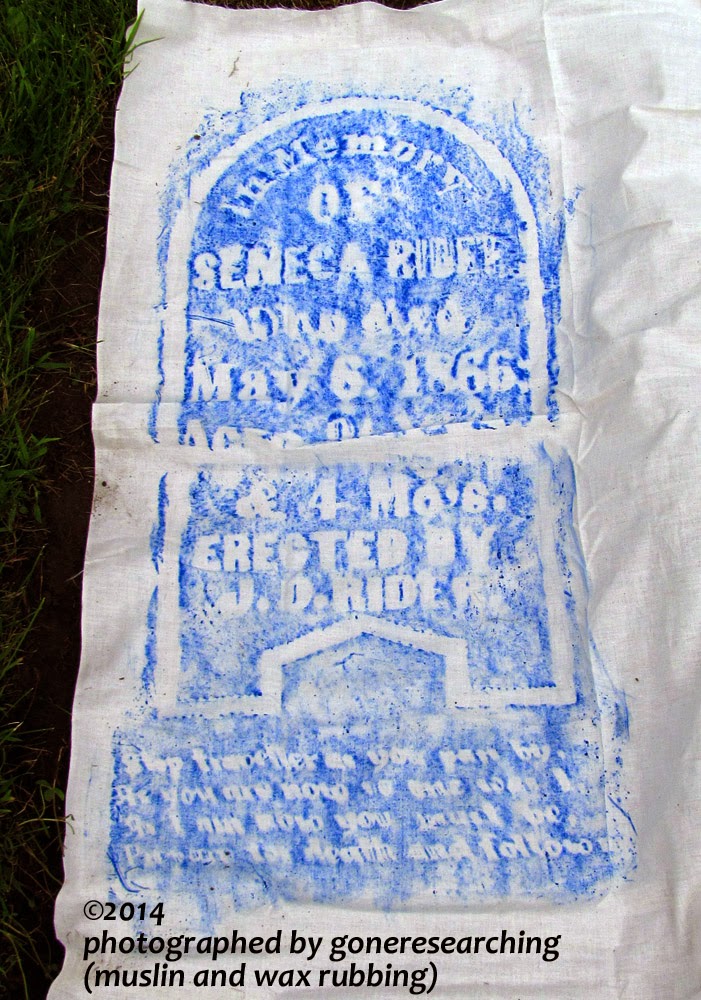
Note: With regards to the tombstone for Seneca Rider, we have visited this tombstone several times since the mid-1990s. The crack has been worse and has been better. I have photographs of it when you could still piece together/make out, "Age 91 years." Between my photographs and now the rubbing, this stone will be preserved in one way or another.

©2014, goneresearching. All text and photos in this post are copyrighted & owned by me (goneresearching) unless indicated otherwise. No republication (commercial or non-commercial) without prior permission. You may share (tell others) of this blog as long as you give credit and link to this site (not by downloading or copying any post). Thank you.


Saturday, August 30, 2014

RIP: Grandma Martha Dunham Rider

129 years ago today, on August 30, 1885 (it was a Sunday that year), my fourth great grandmother Martha Dunham Rider died.

In all the years that we have been placing red geraniums (sometimes pink) and white impatiens (lately petunias) on our ancestors' graves, we have never been able to do so for Grandma Martha. The reason why is that they left no death record for her and her resting place is unmarked.

We figure she is buried in one of two cemeteries near Capac in St. Clair County, Michigan. But both cemeteries lack records and what records they have are recreated based on existing tombstones.

So Grandma Martha here are some virtual flowers for you. Rest in Peace and know that you are remembered.


©2014, goneresearching. All text and photos in this post are copyrighted & owned by me (goneresearching) unless indicated otherwise. No republication (commercial or non-commercial) without prior permission. You may share (tell others) of this blog as long as you give credit and link to this site (not by downloading or copying any post). Thank you.

Sunday, August 17, 2014

Happy Birthday to my 4th Great Grandma Martha DUNHAM RIDER

It is August 17, 2014. And, today would have been her 217th Birthday. She was one of my fourth great grandmothers on my father's side. Her name was Martha DUNHAM. 

Martha and her family are currently the pile of bricks that I am remodeling from a wall into ... my family history. 

Granted one link is held together by circumstantial evidence but it is good reasoning and what evidence/non-evidence I have found that has helped me confirm what my gut has been saying to me for years. Of course, I still seek a record -- any original record -- that says what I have determined for this particular link.

Martha was born 17 August 1797 in Dutchess County, New York. When she was three and a half years old, her parents moved their large family to what was Upper Canada now Ontario, Canada. Eventually, she married Seneca RIDER.

That is all I can say at present, I am writing this family's story and I am hoping to submit it for publication. Not the whole family's ancestry (there are others working on that) just the details on her parents and their descendants which have not been told before.

So Happy Birthday, Grandma Martha!